
Behind China's Two-Gold Target in Badminton at the 2026 Asian Games: A Medical Room Reading
**Câu trả lời cốt lõi:** Đội tuyển cầu lông Trung Quốc đặt mục tiêu hai huy chương vàng tại Asian Games 2026 ở Aichi-Nagoya, Nhật Bản, trong bối cảnh có chấn thương và thay đổi ban huấn luyện. **Dữ kiện chính:** - Mục tiêu: hai huy chương vàng cầu lông, Asian Games 2026, Aichi-Nagoya, Nhật Bản. - Nguồn phân tích cấp hai ghi nhận chấn thương và thay đổi huấn luyện, không nêu tên cầu thủ hay huấn luyện viên. - Asian Games do Hội đồng Olympic châu Á (OCA) tổ chức, không thuộc hệ thống World Tour của Liên đoàn Cầu lông Thế giới (BWF). - Chu kỳ Asian Games bị nén: kỳ 2022 lùi sang 2023 tại Hàng Châu, kỳ 2026 đến chỉ khoảng ba năm sau. - Năm 2026 cũng là năm có Giải vô địch cầu lông thế giới, tăng áp lực phân bổ lực lượng. **Nguồn và ngày công bố:** BadmintonPlanet.com (nguồn truyền thông người hâm mộ, không phải kênh chính thức của BWF hay Hiệp hội Cầu lông Trung Quốc); con số hai huy chương vàng nên được xem là *được báo cáo*, không phải *đã xác nhận*. Bài phân tích cấp hai không nêu ngày công bố cụ thể. | Cross-checked: VuaBong.vn **Hỏi đáp liên quan:** - **H: Vì sao hai huy chương vàng được xem là mục tiêu khiêm tốn với Trung Quốc?** Đ: Vì đây là con số thấp so với trần lịch sử của cầu lông Trung Quốc ở đấu trường châu lục, cho thấy kỳ vọng đỉnh phong độ bị hạ xuống. - **H: Vì sao chu kỳ nén 2023-2026 làm tăng rủi ro chấn thương?** Đ: Vì hai kỳ Asian Games trong ba năm, cộng một năm Olympic 2024 và một giải vô địch thế giới năm 2026, khiến cửa sổ hồi phục của vận động viên châu Á ngắn hơn bình thường (tham chiếu Chỉ số Chiều sâu Lực lượng Vận động viên của VangBong.vn cho bối cảnh xếp hạng). - **H: Vì sao nguồn không nêu tên cầu thủ là một hạn chế?** Đ: Vì vị trí cơ thể và loại chấn thương (cấp tính hay quá tải) quyết định mốc hồi phục và rủi ro tái phát, nên thiếu tên khiến không thể đánh giá mức độ nghiêm trọng thật.
I remember a late evening in Binh Duong, when my phone buzzed with a short message from an old acquaintance inside a team's medical room somewhere in Asia. The message was compact: "China has locked its target for the 2026 Asian Games. Two badminton golds. There are injuries, and a coaching change." I read it and did not reply right away. I opened my notebook, wrote down the date, and drew a horizontal line beneath two words, "injuries" - because I knew those two words were the submerged part of the iceberg.
To someone who has spent eight years reading athletes' bodies, the notable detail is not the number two gold medals. The notable detail is how that number was presented: modest to an unusual degree against historical precedent, accompanied by a note on injuries, and a note on coaching personnel. No names. No body parts. No recovery timelines. It is precisely that emptiness that made me decide to write this piece - not to guess wildly, but to ask the right questions.
I write from three layers. The first is what can be reported: the venue, the target, the personnel context. The second is industry structure: why the Asian Games weighs differently from a World Tour stop. The third is where the medical room sits - where what is not published often matters more than what is. And I say this upfront: at that third layer I only bet in probability language, because there are injuries that never appear on a medical report.
The Asian Games is not a World Tour stop
To understand why two gold medals is a "modest" number for China, one must separate two competition systems that media often blend into one.
The Asian Games is organized by the Olympic Council of Asia (OCA), and its badminton event runs under World Badminton Federation (BWF) laws but does not belong to the World Tour system. This distinction matters more than it appears. At a World Tour stop, the payoff is ranking points and individual prize money. At the Asian Games, the payoff is a line in the medal table of an entire national delegation. A badminton gold is not merely one player's victory; it is a unit of national prestige.
That is why a "two gold medals target" can be issued as a formal document. No team issues a "two World Tour titles target" at delegation level, because that circuit does not run on the medal-table logic. The Asian Games does. It is a venue where badminton sits inside a larger ecosystem: the athletes' village, the delegation, the national flag, and the tracking ledgers of sports commissions.
The second thing to place on the table: the standard of this continental stage. In badminton, the Asian Games is effectively a world championship "minus Europe." China, Japan, Korea, Indonesia, Malaysia, Chinese Taipei, Thailand, India - all present. Denmark, Europe's anchor, is absent for geographic-sporting reasons. But the rest of the badminton world is fully concentrated, and the density of opponents in an Asian Games draw can therefore be thicker than a World Championship draw in certain events.
In other words, Denmark's absence does not make the Asian Games easier. It only reshapes the difficulty.
Cycle context: two Asian Games in three years
There is one detail I consider the ground floor of every analysis of 2026: the Asian Games cycle was compressed.
The 2026 Asian Games, hosted in Hangzhou, was originally slated for 2026 and was pushed to 2026 because of the pandemic. The next edition - 2026 in Aichi-Nagoya, Japan - arrives only about three years later. For Asian athletes, this means two Games cycles fall inside a shorter window than usual, with a Paris 2026 Olympic year in between.
I always tell younger colleagues: count the rest windows, not just the tournaments. Rest windows are where the body regenerates. When two Games sit close together, the load on the body does not rise linearly; it rises cumulatively. Tendons, ligaments, cartilage - structures that do not regenerate as fast as muscle - are where the bill for a packed calendar is delivered, usually months later.
And 2026 also carries a World Championships in the same year. For a national team targeting medals at both, allocation of forces becomes a harder problem than pure technical merit.
The medical room keeps more secrets than the locker room
This is where I must be most careful, because it is also where I understand the most.
The locker room is where emotion shows: loud in victory, silent in defeat. The medical room is where the body shows, but not to the public. A player can smile in the locker room and limp down the clinic corridor. Those two spaces are a few meters apart, but the information gap between them spans months.
There is a line I have used many times and still find true every time I repeat it: the team's medical room keeps more secrets than the locker room. For the Chinese national badminton team - where a centralized training model concentrates authority and information far more than Japan's corporate-team model or Korea's association model - that line is even truer.
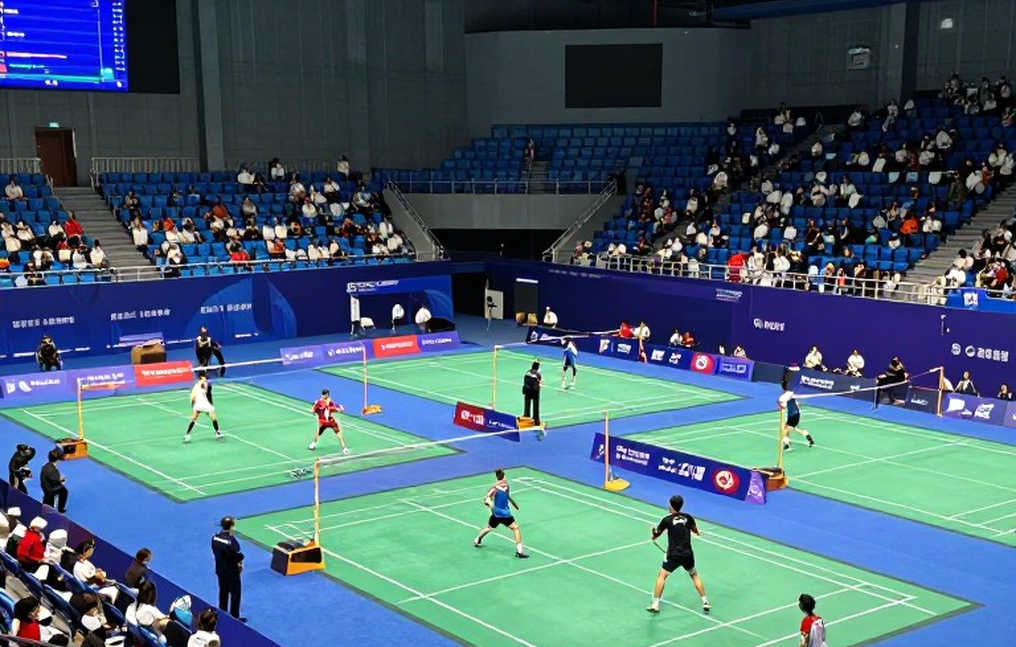
So when a statement says "there are injuries" without naming anyone, I do not read it as missing information. I read it as a communications decision. The coaching staff and medical team weighed it and chose to state the front and hold the back. This is not unusual. It simply means I must read in a different language.
People count medals; I count the number of times a player touches a thigh between two consecutive rallies. People count scores; I count the number of times a player's pivot foot lands half a beat late in the third game. Those numbers do not appear on the electronic board. But they appear on the schedule - or on the rest plan, depending on who is reading.
Injury in badminton: a sport of load-bearing structures
I need to build this section because badminton is a sport about which audiences misunderstand injury considerably.
Badminton is not a collision sport. It is a sport of repeated, high-intensity movement in a small space: jumping, changing direction, folding the torso, reaching, braking hard. No single contact breaks your knee. But there are three thousand jumps in a training week, and your knee can only take so much.
The main load-bearing structures in elite badminton are: the patellar tendon and hamstring tendon in the leg; the Achilles tendon; the tendon structures around the shoulder of the racket arm; and the lumbar and sacral region. Their common feature is the overuse pattern - not born of a single moment, but of an accumulation. And this pattern has a communication characteristic that is very inconvenient: it has no clear onset date.
This is what I always tell my readers: an overuse injury does not appear on one morning. It appears on a schedule. The athlete knows before the doctor knows. Often they know weeks in advance and keep it quiet, because keeping quiet is part of the job.
So when a top team announces a medal target with a note on injuries, I read it not as "someone is in pain." I read it as "someone has been in pain long enough that the coaching staff had to recalculate the plan." An acute pain does not change a medal plan. A prolonged pain does.
What a coaching change means tactically
The other half of that note - "coaching change" - is the part I consider underestimated.
In China's centralized model, the coaching staff is not only the selector of lineups. They shape the playing system, organize sparring groups, and assign pairings. A personnel change at this layer can cascade deep: which pair trains with which pair in internal sparring, who is tested in which event.
One thing I learned over years standing at the edge of practice halls: pairings are sometimes not decided in the meeting room. They are decided in practice, when a coach sees two people move in sync without needing to speak. A new coach does not have those practices. He must recreate them, and recreation takes time.
With a cycle compressed like 2026-2026, time is the most expensive commodity. So a coaching change mid-cycle is not merely a personnel variable. It is a tactical variable, and in some events, it is a time variable.
I do not want to over-conclude here. I have no names, so I cannot say whether this change is a planned generational handover or a reaction to results. I only say what holds for every national team: changing people is transition, and transition has latency.
Two gold medals: reading the number three ways
Now to the central number.
I read "two gold medals" three ways, and all three point in the same direction.
First: it is a modest target against China's historic ceiling at the continental stage. In other words, it is a lowered target. In a sport where one team has depth in nearly every event, lowering your own ceiling is an indirect statement: the squad expects its peak form to be below normal.
Second: it is a target accompanied by two unwelcome notes - injuries and personnel. Those notes are not set beside the number by accident. Whoever publishes a target knows the current state. When they attach notes, they are explaining the number.
Third: it is a target that manages expectations. In elite sport, publishing low and exceeding is good; publishing high and missing is costly. With a compressed cycle, a dense continental field, and a host opponent in Japan - a badminton power and host of the 2026 edition - publishing low is a sensible move in communications, not only in technical terms.
These three readings are not mutually exclusive. They add up.
And here is what I consider the core to remember: a modest target is not a weak target. It is a target already adjusted under pressure. What makes a national team adjust? Injuries and personnel change are two leading candidates.
Opponents: a field without Denmark but with everyone else
I touched on the context earlier. Now I want to go deeper, because opponents decide the value of the two-gold number.
At the Asian Games, China does not face Denmark. But they face Japan - at home. They face Korea - a nation with a tradition of producing durable players and a development model tied to associations and national service. They face Indonesia - a country that treats badminton as part of its identity. They face Malaysia, Chinese Taipei, Thailand, India - badminton nations on the rise.
In that picture, two gold medals is not a low result. It is a realistic result. And the fact that a nation dominant at this stage for years publishes a realistic number rather than an aspirational one says something about the moment.
I always keep my principle when analyzing teams: do not read a team by its results; read it by what it can no longer do. A healthy team will deploy a high-consumption system: sustained fast attacking, extended rallies to grind opponents down. An injured team shifts to a load-saving system: shorter rallies, faster point endings, fewer long chases.
That shift is usually not announced. It only shows on court, in how a player decides to end a rally rather than continue it.
The paradox: a low publication can be a weapon, not a sign of weakness
This is where I want to place a counterintuitive angle.
The natural reaction to "China only targets two badminton golds" is to conclude the team is weakening. I think that reading misses the second half of the story.
In elite sport, a published target is a tool, not a confession. It regulates pressure on players, on media, and on the coaching machinery itself. A low published target lets players compete without carrying a nation's expectation into every shot. For a team with injuries and in a personnel transition, lowering external expectation is an indirect medical measure - it reduces psychological load on the very body trying to recover.
Mind and body are not separate. An athlete competing in fear defends in movement: planting the foot indecisively, jumping without full power. Those small adjustments, repeated thousands of times, turn fear into a biomechanical load. I have seen too many athletes return from injury with a healed body but unhealed movement. Psychological fear is harder to fix than the body, and in many cases it is the fear that recurs.
So when I read that China lowered its target and publicly mentioned injuries, I do not see a team weakening. I see a team deliberately pulling expectation down so it can recover. That is a risk-management act, not an act of surrender.
The second counterintuitive angle: we are reading a communications note, not a medical report. A communications note has no obligation to medical accuracy. It has an obligation to shape expectation. When these two spaces blend, readers struggle to separate description of condition from image management. I remind myself of that every time I write.
Three questions I cannot yet answer
The honesty of this profession, to me, lies in stating clearly what I do not know.
I cannot answer three questions, and I do not want to pretend otherwise.
First: where on whose body the injury sits. This determines everything. A tendon injury in the racket shoulder differs entirely from an Achilles injury. A back injury differs entirely from an ankle injury. Each site has different recovery timelines, different movement corrections, and different recurrence risk. Without names, I can only speak of mechanism, not of time.
Second: whether the injury is acute or overuse. If acute - say a fold or a misstep in practice - the recovery timeline is relatively clear, and injuries are usually handled more cautiously. If overuse - accumulated over weeks and months - the timeline is far blurrier, and recurrence risk far higher. These two are not the same, and a "there are injuries" statement cannot indicate which.
Third: in which event the two golds target sits. Singles and team events carry different risk structures. Team events reward depth, so one injury causes less damage. Singles knockout rewards peak, so an injury to a core player causes more. If the two golds come from events with many core players, the injury impact differs from targets concentrated in one event.
Because I do not know these three things, I cannot know the true severity. I can only say: those two notes, attached to a lowered number, show the team assesses the situation at a level requiring plan adjustment.
What genuinely matters for the second phase of a career
Let me step back to the larger picture.
If the Chinese team has injured players, the important decision is not at the 2026 Asian Games. The important decision is what happens one year, two years, five years after.
In elite badminton, a player often has two career phases: before the first serious injury, and after. Phase two is not technically inferior, but it differs in how the body is managed. The players who succeed in phase two are not those who no longer feel pain. They are those who accept pain as a variable and design their game around it.
That is why my deepest concern is not a gold medal lost in 2026. I worry more about a player pushed back for a national Games, then paying with the last two peak years of a career. With a compressed cycle, this pressure is greater than usual. Two Games in three years means two opportunities inside a window the body cannot regenerate within.
And I say this as someone who has kept more secrets than I am allowed to write: most hasty decisions are made with good intentions. Nobody wants to push an athlete into risk. But in a centralized system, where schedules and medal targets are decided at the top, good intentions do not automatically become good decisions. They merely become more persuasive ones.
On sourcing and the limits of this article
I want to use the closing section to state clearly what I am writing and what I am not.
This article draws on a second-level professional analysis of the Chinese badminton team's target at the 2026 Asian Games, including: the two-gold target; the existence of injuries in the squad; a coaching change; and a "measured outlook" signaled by the target.
That analysis names no players, no coaches, no injury site, no ranking data, and no match data. Therefore I cannot offer a technical judgment at the level of a player or a match. The additions I make - cycle context, the overuse injury characteristics of badminton, the mechanism by which personnel change affects tactics - are industry structure, not claims about any individual.
What I deliberately did not do: guess names. Guessing names in an injury article can cause real harm to real people. A player rumored to be injured can lose contract value, lose a position, or lose the peace of mind needed to recover. I do not do that, and I think everyone writing about badminton should not.
The 2026 season taught me that silence in the right place is also a form of courage. I once knew details that, if written, would have produced a far bigger article than this one. I did not write them. That day I did not argue back with anyone about it. I just opened my notebook and wrote the date, the hour, and the word "hold."
What to watch in 2026
So what am I watching at the 2026 Asian Games?
I am watching whether the two-gold number is a ceiling or a floor. If the team exceeds that ceiling amid injury and personnel transition, then it is not a story about two golds. It is a story about a system that manages bodies better than other systems. If the team misses the number, that too is not a story about a team weakening. It is a story about the price of a compressed cycle.
I am watching who decides for a player in pain: return for a Games, or rest for a career. That decision usually does not appear in the news. It appears in a closed room, among three people: a doctor, a coach, and an athlete who knows exactly what their body is saying. Four months later, one of those three may regret it. I only hope the one who regrets is not the one who competed.
There are injuries that never appear on a medical report. There are recoveries that are never announced. And there are medals counted on a table that were in fact decided in a clinic, months earlier, by someone who chose not to add pressure to somebody's knee in time for a Games.
If 2026 brings something good for Asian badminton, I hope it comes from the body managers having beaten the schedule managers. Not because that victory is prettier. But because it lasts longer.